Hair transplant swelling explained: why it happens, why it migrates to the forehead and eyes, the day-by-day timeline, and how to reduce it. Clinical guide by Dr. Arslan Musbeh.
Why Hair Transplant Swelling Happens
Swelling (oedema) after a hair transplant is a normal, expected part of healing — not a complication. It has two sources. First, the local anaesthetic and tumescent fluid injected into the scalp before extraction and implantation temporarily expand the tissue. Second, the body's inflammatory response to thousands of micro-punctures increases blood flow and fluid retention in the treated area. Both resolve naturally as the tissue heals.
Why Swelling Moves to the Forehead and Eyes
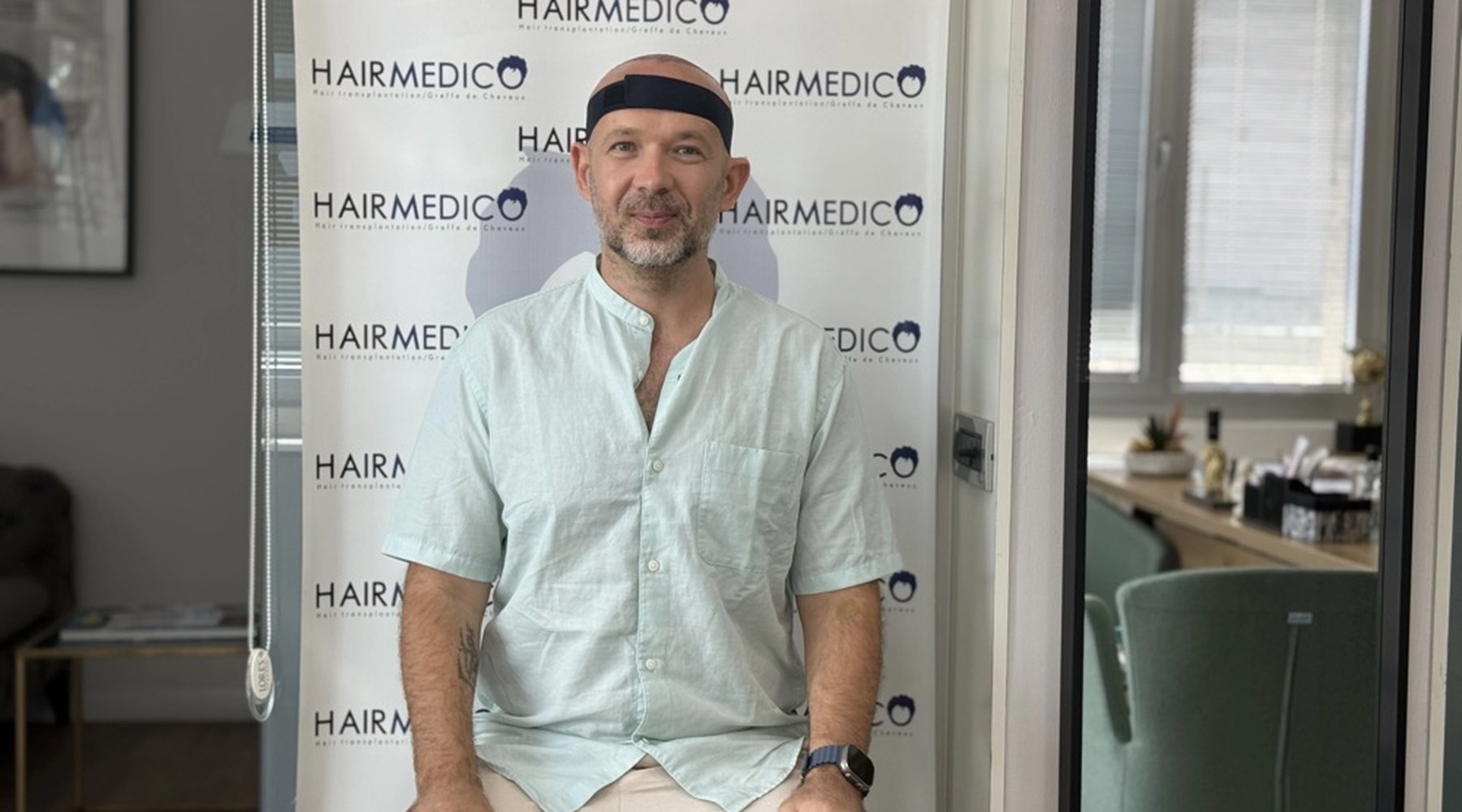
This is the detail that alarms patients most, and the one nobody warns them about clearly enough. The scalp and forehead sit on a layer of loose connective tissue with no rigid barrier between them. Fluid follows gravity: over the 2–4 days after surgery, it gradually migrates downward from the recipient area, through the forehead, and can settle around the eyes as periorbital puffiness or mild bruising.
This is called dependent oedema and it is a mechanical, gravity-driven process — not a sign that anything has gone wrong. It typically affects the forehead more than the crown, and DHI procedures (which use more implantation fluid) tend to produce slightly more forehead swelling than FUE.
Hair Transplant Swelling Timeline — Day by Day
| Timeframe | What to Expect |
|---|---|
| Day 0 (surgery day) | Minimal swelling visible. Scalp feels tight from anaesthesia and tumescent fluid. |
| Day 1–2 | Mild forehead swelling begins. Recipient area may feel firm. |
| Day 3–4 | Peak swelling. Fluid has migrated to the forehead and, in some patients, around the eyes. This is the most visible day for most patients. |
| Day 5–7 | Swelling recedes rapidly. Any periorbital puffiness or bruising fades. Most patients are close to normal by Day 7. |
| Week 2 | Swelling fully resolved in the vast majority of patients. Mild residual tightness may remain. |
| Week 3+ | No visible swelling. Focus shifts to redness fading and the shock loss phase. |
Roughly 1 in 10 patients experience little to no visible swelling at all — the degree varies by individual healing response, graft count, technique and how closely aftercare instructions are followed in the first 72 hours.
How to Reduce Swelling
None of the following steps eliminate swelling completely — the process is a normal healing response — but they meaningfully reduce its severity and duration:
- Sleep elevated: Keep the head raised at a 30–45° angle for the first 5–7 nights, using two or three pillows or a recliner. This is the single most effective measure — it prevents fluid pooling overnight, when most swelling accumulates.
- Cold compress: Apply a cold (not frozen) compress to the forehead — never directly on the grafted recipient area — for 10–15 minutes at a time during the first 48 hours.
- Avoid bending forward: Bending at the waist or lying flat increases blood flow to the head and worsens fluid pooling. Pick items up by bending the knees instead.
- Limit salt intake: High sodium intake increases fluid retention throughout the body, including the healing scalp. Keep meals light on salt for the first week.
- Avoid strenuous activity: Exercise, heavy lifting and bending increase blood pressure to the head. Rest for the first week; resume light activity gradually from Week 2.
- Stay hydrated: Adequate water intake supports normal lymphatic drainage — counterintuitively, dehydration can worsen fluid retention.
When Swelling Is Not Normal
Mild asymmetry is common — most patients sleep favouring one side, and swelling often reflects this. Contact the clinic promptly if you notice: sudden, severe one-sided swelling with significant pain, swelling accompanied by spreading heat and redness, fever above 38°C, or swelling that continues worsening past Day 5 instead of receding. These can indicate infection or, rarely, a haematoma (a pocket of blood beneath the skin) requiring assessment. At Hairmedico, the 12-month WhatsApp follow-up means any concern receives a specialist response within 24 hours — not a call centre.
→ Internal links: Hair Transplant Istanbul | Dr. Arslan Musbeh | Packages & Pricing